

CBT for Alcoholism
 Cognitive Behavioural Therapy (CBT) is an effective, practical solution backed by extensive research. It can be used for any number of mental health problems or behavioural issues, including of course, alcoholism.
So how does CBT work in relation to alcoholism, what is the process? And, as you’re probably wondering, how will it help you to solve your own alcohol problems?
Alcoholism is different for everyone; the reasons why you drink are not the same as the reasons someone else drinks. So the first step in solving your issues with alcohol is to explore where your drinking fits into your life, what contributes to it, and what might be maintaining the problem? CBT is a method for helping you to examine your thinking styles, your beliefs, and your interpretations of the various aspects of your life, to see if they are unhelpful for you, and particularly to see which ones are fuelling your alcohol consumption.
Once we’ve established a few priority issues to focus on (like work stress, or relationship problems, worry, or depression perhaps) you can practice some pragmatic changes to see which ones are most effective for you, and which ones help you reduce your alcohol intake. Part of what makes CBT so effective is that it’s individually tailored to you and your specific problems, it’s not just a set of instructions to follow.
Alcoholism is a difficult problem to solve though, so the best intentions don’t always work out as you expected. Dealing with mistakes and learning from them is key to this, without criticising yourself. As such, predicting your most likely triggers for drinking is vital, so plans can be developed for how to handle such situations differently.
Another key difference with CBT for alcoholism is that abstinence is not the only option (unlike AA for instance) - most people find they can successfully cut down how much they’re drinking, once they start handling some other aspects of their lives a bit better. Equally, CBT allows you to learn new approaches to problems, without solutions being ‘implanted’ in you, as in hypnosis.
If you’re curious about how CBT can help you, make an initial enquiry with our contact form in the top menu.
 Unfortunately, drinking too much alcohol can make people feel ashamed, especially if you believe that drinking excessively suggests there is something defective about you. Or you believe it is something that needs to be hidden from other people, as you fear their judgement. This is the nature of shame, it is a particularly negative feeling, and is often a factor in depression. It is usually tinged with regret of course, at having done things while drunk that we would never do sober - perhaps hurting other people or behaving inappropriately.
 There’s been a lot of media attention on Mindfulness lately, but not so much on how useful it is for dealing with an alcohol problem. So how does mindfulness help us deal with mental health problems generally, and with alcohol issues specifically?
 Worry is a normal human activity - we all do it from time to time. But for some people, it dominates their life. So how can you stop worrying? The initial answer is that it’s unlikely you’ll be able to stop completely, but you might be able to reduce it. Before we proceed, lets define what worry is.
 Treating depression takes a long time, as it requires various long-standing patterns to be changed.
 low mood most days (feeling sad or empty)
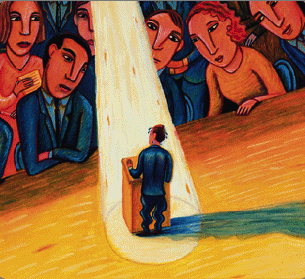 There are several factors which contribute to social anxiety, and each of them needs to be addressed for the whole problem to be dealt with.
 Where you focus your attention is another important factor in reducing social anxiety. You probably pay close attention to the bodily symptoms of your anxiety when you experience it – you become self-conscious, and this acts as a feedback loop because you judge your own anxiety symptoms, making them seem more alarming to you, and so they get worse.
 Social anxiety is a common problem, characterised by being apprehensive and nervous about potential rejection or humiliation by other people.
 “I wish I could quit drinking so much, but I just don’t have enough willpower”.
 A survey by the British Association for Counselling and Psychotherapy (BACP) has found that talking therapies are becoming more acceptable in UK culture, people are less embarrassed to admit they have had therapy, and more would consider it as an option than they used to.
 A lot of people consume alcohol as a way to manage stress. How often this is effective as a coping strategy probably decreases as the amount you drink increases. But although alcohol doesn’t really work as a long-term way of handling stressful situations, it does provide relief in the short term. And this is where the problem starts.
 We all make mistakes from time to time, it’s inevitable. But how you react to them can make a big difference to your self esteem.
 Similarly, how you respond to your alcohol consumption has an impact on how you feel about yourself. If you drink more than you intended one night, you might judge yourself for it, saying something like “you’re such a loser, you got drunk again”. The consequences of such a thought are probably feelings of hopelessness and
  As if you needed another excuse to have a drink. Now researchers in Spain have conducted a study of 40 000 people and found that those who drank alcohol regularly tended to have a lower risk of a heart attack than those who were teetotal (particularly for men over the age of 40). And the more you drink, the greater the protective effect.
 A recent research study published in the Journal of Technology in Human Services has demonstrated the effectiveness of online psychotherapy for mental health problems.
 Many of you will say that you need a drink in order to sleep, that alcohol actually helps you sleep better. While it may be true that drinking will get you off to sleep quicker, unfortunately the quality of your sleep will be much worse overall.
 An important factor in solving your problems with alcohol is talking to other people who understand what you’re going through, who won’t judge you for it, and who will genuinely share their experience without just trotting out the old clichés about drinking.
 Luckily there is now the option of communicating online, where the screen can grant you a cloak of anonymity. As such you can join our