Binge Drinking
There is no commonly agreed definition of what binge drinking is, in terms of an actual amount of alcohol defined by the medical profession. But we all know what it means: drinking much more than you would normally drink in any one occasion.
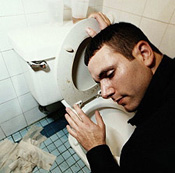 This is not limited to alcoholics of course. However, binge drinkers don’t drink every day, and so they may not consider that they have an alcohol problem.
The effects of binge drinking on the individual, on those around them and on society generally are widespread. The health implications are serious, including alcohol poisoning and accidental death.
The social functioning and work performance of binge drinking individuals suffers markedly. Hangover related absenteeism and poor job performance was estimated to cost the US economy $148 billion in 1998.
Violence, accidents and crime rates soar on weekend nights as a result of heavy drinking – 80% of hospital emergency admissions at night are intoxicated by alcohol. Of course the biggest cause of accidents and death related to alcohol consumption is the motor car.
This problem is no longer restricted to men. Younger women particularly are now drinking until they are very drunk, at least as much as young men. The incidence of unwanted or unsafe sexual activity reported by young women increases dramatically when they and those around them have been drinking excessively. After binge drinking, one in seven 16 – 24 year olds have had unprotected sex, one in five have had sex they regretted later and one in ten have been unable to remember if they had sex the previous night (Health Education Authority (HEA/BMRB 1998b) Sexual health matters: Research survey).
Are you drinking too much?


The past year I have found myself drinking more i.e. all weekend out with friends and family a few bottles of wine here and there but me and my partner have come to a halt. He said he can no longer proceed in living the life he is with me, he is miserable when I drink and he said my behaviour is getting him down, I am so flirtatious, my manner changes and I get really cocky. He has told me this morning to get out of the house. The only thing is we have a 4 year old daughter and I don’t want us splitting up as I don’t want to be on my own. I keep saying I will change and wont drink and then do ! what can I do to help myself???? I don’t want to split up and don’t want to make him miserable no more but don’t know what to do ???? Do I stop drinking ? What would I say to other people why I don’t drink ? What do I do to change ? I don’t want to loose my partner - can someone please help me ????
drinking was the first step in getting in the group then it was the fags then some stupid stuff then stealing that was me in thr group i was happy
i dont know what got in to me my mum started smoking them i started then my friend started then she stopped then i stopped i dont get that but it saved my life
hi i remember when all my friends started drinking they pressured me in to it but i just said no and i walked away from all of them 3 months later i started smoking that was the rgret of my life
Its funny. People have said that I am an alcoholic. I have lost many friends. Been arrested about 7 times due to alcohol related incidents. None of them DUI. I was kicked out of a fraternity becuase of an arrest. I have had a really tough life in the past five years. I started drinking at age 18 and since continued binging all through out those years. I did graduate college and usually was completely sober Sunday-Thursday and a couple of weekend nights per semester. The last three years has been lonely and sad. I have been living with myself on my own and still binging. I did cut back significantly in the past four years. Now I am drinking on average a 12 pack a week and always have the desire to binge. It has been about two weeks since the last binge and on average I drink two beers a night. If I binge again my next day will be ruined. The week will be ruined and my anxiety will peak back sometimes to the point where I don’t want to leave the house.
I know where I stand right now. Going to AA meetings and seeing a therapist helped out although i was still drinking. I told the therapist a couple of months ago that I usually binge once a week and trying to do it only once every week and a half. It was helped but not a lot. What a waste for just that binge. I quess thats the life on a binge cycle alcolic. You go back to the whole you started the day after you binge. Furtunately I can still drink in moderation which is what I usually do most days of the week…taking 2 sober days. Its now two weeks and I really want to know what its like getting to a month. I think the longest I went without a binge is two and a half weeks. On celebrity rehab Dr Drew said to a Patient the binge cycle alcoholics sobreity is a mechanism for start again, then do the same in the next week. It sucks and I know that I have a long way to go in my sobriety… NO BINGING. Please…. Just make it another 2 more weeks.